In 2021, FutureProofing healthcare initiative launched a health policy index known as the African Sustainability Index. 18 African countries were studied and ranked across six vital signs. Nigeria ranked 14th with a total score of 44 over 100. The country’s low performance is a reflection of the poor state of the health sector and inadequate budgetary allocations to improve the sector. For instance, Nigeria spends 3.89% of its GDP on the health sector, a figure that is proportionately lower than the 5% suggested by the World Health Organization (WHO). Nine years to the 2030 sustainable development goals, Nigeria is still far behind in universal health coverage (UHC). According to the World Health Organization, monitoring UHC means focusing on two key aspects: i) the proportion of the population that can access quality health care and ii) the proportion of a population that spends a large amount of household income on health. This categorizes the focus on UHC into access and financing. In this article, health finance will be the Focus while the third article in this series will discuss access to quality care.
Based on the African Sustainability Index ranking, Nigeria is the 4th lowest country in health finance, with a score of 36. This indicates lapses in Nigeria’s current health financing model, primarily based on households’ out-of-pocket expenses, compared to the tax, health insurance, and donor funding-based models predominant in other environments. According to the WHO, for a healthcare financing model to be considered efficient, the population should not spend a large amount of their income on healthcare. Unfortunately, this is not the case in Nigeria.
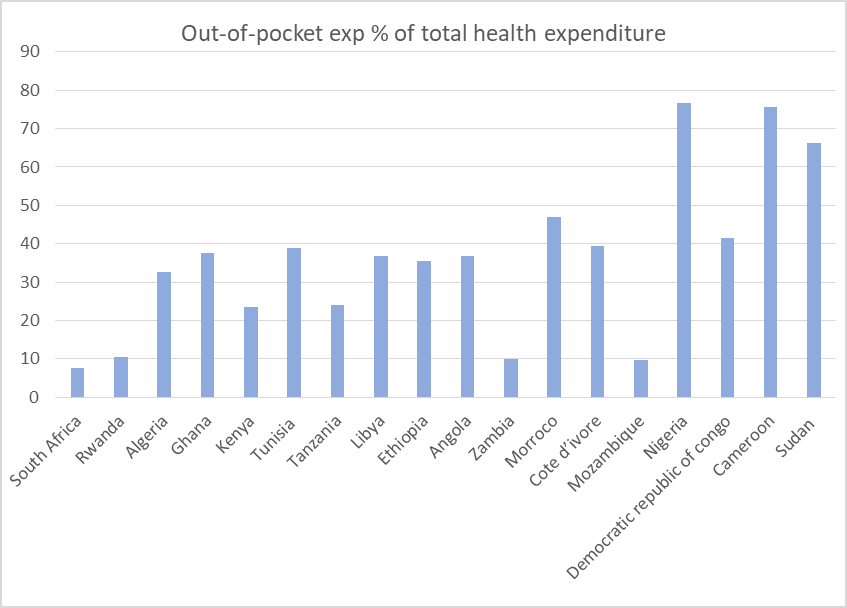
Health care in Nigeria is financed by mostly the out-of-Pocket model. About 69% of Nigerians finance their healthcare needs from personal savings or income. Regardless of their income, they have to pay for any health service rendered to them as well as the cost of drugs. The graph below shows the percentage of total health expenditure financed by out-of-pocket payment in the 18 African countries evaluated by the Future-Proofing initiative. The countries in the graph are placed according to their rank in the financing index. The graph shows that Nigeria has the highest level of out-of-pocket payment amongst the 18 countries. Although the graph does not show a clear relationship between out-of-pocket payment and position in financing, we can observe that the countries with an out-of-pocket rate above 50% are in the lowest rank of financing.
Source: World Bank data, 2018
Out-of-pocket payment is a hindrance to health care given that over 40% of the population live below the country’s poverty line of $0.8 a day (World Bank, 2020). In fact, with the high rate of inflation, an additional 7 million people have been pushed below the poverty line according to a World Bank report in 2021. For instance, the cost of a complete malaria medication is $3 which is approximately 1500 naira. The hospital consultation fee varies between $2 and $50 depending on whether the hospital is private or government-owned. These costs, combined, outstrip the minimum wage of $53 and therefore beyond the reach of many. Government-owned hospitals which is usually the cheaper option would have been the solution to this dilemma but the financial burden is still higher than the estimated poverty indicator. The remaining 60% of the population living above the poverty line are not better off, they still grapple with high medical bills.
Recently, a growing number of the population is being financed by the National Health Insurance. The National Health Insurance Scheme (NHIC) was implemented in 2005 to pool health risks at the national level. The scheme is designed in a way that every member of the society irrespective of economic status would be covered. However, as of 2019, only 5% of the population were enrolled in the scheme. One reason for the low enrolment rate could be because the government has not made it mandatory for individuals in the informal sector. With Nigeria’s huge informal sector (about 70%), one can most certainly say that the scheme is inherently not mandatory. Even within the formal sector, some private employers do not provide basic health insurance coverage for their staff. Another factor that could contribute to the low enrollment rate is unawareness on the part of the populace. Some Nigerians, especially the uneducated populace are unaware of the insurance scheme. Some of those who have heard may not fully understand its implications and advantages over out-of-pocket payment. Hence, they may decide not to enroll in the scheme. In addition, apathy for government-run programs could contribute to the general low coverage in over 10 years.
Though relatively small, another source of healthcare funding in Nigeria is donor finances. These funds come from Non-Governmental Organizations, international organizations, faith-based institutions, and private donors. The donations often come in the form of medical equipment and consumables, drugs, blood banks, vaccines, and funds for hospital construction or renovations. These funds are often targeted at the poor and vulnerable and major disease-burden such as Malaria, HIV, Tuberculosis, Hepatitis, Cancer screening, and eye treatment. In as much as these donor programs have their impacts, they are generally inadequate and not readily available to cover the (infrastructure) financing gap in the health sector.
There is an urgent need for Nigeria to create a pro-poor health financing plan to bring about equity in the country’s health care system. This will entail more government involvement in health financing. The first step could be to optimize budgetary allocation to the health sector. In the Abuja declaration of 2001, African countries were urged to allocate 15% of their budget to the health sector. In the past 2 decades, Nigeria’s average allocation to health care is 4.67%. Eliminating financial barriers to quality and effective health care is another option to be explored. With the high poverty rate, risk pooling methods could be an effective method of eliminating the financial barrier. Insurance and tax-based financing methods are the top risk pooling methods of health financing. Although Nigeria already has the NHIS, more sensitization should be carried out to create awareness and encourage mass enrolment in the scheme. In all, effective health care finance is the first action towards revamping the entire health sector.
At the 2021 African Health Agenda International Conference (AHAIC), the FutureProofing Healthcare Initiative launched the Africa Sustainability index. The index is a data-driven policy tool that aims to measure the healthcare situation of 18 African Countries. These 18 countries were assessed based on 6 vital signs upon which a total score was obtained as well as an overall rank. The 6 vital signs examined are access, financing, health status, innovation, quality, and wider factors. Nigeria ranked 14 out of the 18 countries evaluated, with a total score of 41 over 100. South Africa, Tunisia, Morocco, Algeria, and Ghana were ranked in the top 5 while Nigeria, Cameroon, Angola, Sudan, and the Democratic Republic of Congo ranked in the bottom 5. All 18 countries were also ranked based on their performances in the respective vital signs. Nigeria’s best ranking was 6th under the Innovation vital sign, while the worst ranking was 17th under the vital sign Health quality. The general performance in the innovation vital sign was however poor as Nigeria ranked 6th with a score of 38.
Nigeria’s performance in the Sustainability index is not impressive and begs to question whether growth measures in Nigeria are merely quantitative. To put things in perspective, Nigeria has a GDP of USD 400 billion, the largest in Africa, but ranked among the least performers. Meanwhile, South Africa, Algeria, Morocco, and Ghana that ranked in the top 5 on the index are among the top 10 GDP in Africa, suggesting some correlation between GDP and performance in the African Sustainability index (or better still, healthcare infrastructure). However, Nigeria’s performance defies this intuition. How does a nation with such economic strength perform abysmally in a health index?
Many factors explain the distortion from GDP to poor healthcare delivery as captured in the health index. For instance, low health sector spending to GDP of less than 4% (global average is 8.8%); low budgetary allocation to the health sector to increase the supply of critical infrastructure or low health workers per capita amongst others are some of the challenges in the health sector. In the Abuja Declaration of 2001, heads of state of the African Union countries pledged to allocate 15% of their annual budget provisions to improve the health sector. According to a report by dRPC, in those 20 years, Nigeria allocated only 4.7%, on average, to the health sector – the highest allocation of 6.08% was in 2012. In 2020, allocation to the Ministry of health was 4.05% (from 3.83% in 2019) – a marginal increase despite the pandemic. Only Rwanda and South Africa have the 15% benchmark as of 2011; Nigeria is apparently off track at 4.52% in 2021.
The role of institutional factors constraining health sector performance can not be overlooked. Some institutional factors that stymie health sector performance directly and indirectly include:
Weak Institutions: Over the years Nigeria has set up various institutions and reforms in the health care sector. For example, in 2004 the National Health Insurance Scheme (NHIS) was established to tackle the challenges to healthcare access and financing at the household level. Nigeria’s performance on the Financing vital sign implies that the NHIS has not been very effective. For instance, the NHIS is largely not mandatory; and that weakens its effectiveness especially in the informal sector. Consequently, insurance coverage in Nigeria is still at less than 5%. In 2018 76.6% of current health expenditure in Nigeria is still out-of-pocket. A robust scheme and implementation framework are necessary to ensure the effectiveness of institutions, policies, and reforms to achieve a far-reaching impact on society.
Political instability: Insecurity, terrorism, and violence create an unsafe and tense environment for all sectors in an economy including health. Nigeria has an average score of -1.8 on the Political Stability index calculated from 1996 to 2019. The political Stability index range from -2.5(weak) to 2.5(strong). For comparison, South Africa and Tunisia have an average value of -0.15 and -0.27 respectively for that same period. With civil and political unrest, health infrastructures are destroyed. Qualified health care personnel are often discouraged or scared of providing services in conflict-prone areas. This creates a wide disparity in access to healthcare. Often, the international community intervenes with voluntary workers such as the Doctors without borders and Red Cross.
Corruption: Transparency International defines corruption as the abuse of entrusted power for private gain. This means the misappropriation of funds and resources meant for a particular public good. Nigeria ranked 149/180 in the corruption perception index with a score of 25/100. For Comparison, South Africa and Tunisia both ranked 69/180 with a score of 44, while Cameroon and Angola ranked 15th and 16th in the African Sustainability index ranked 149/180 and 142/180 respectively in the corruption perception index. The NHIS is a regulator and an operator which is in contravention to the Act stipulating that it should function as a regulator with defined roles. Also, poor supervisory activities create leeway for the hospitals and Health Maintenance Organisations (HMOs) to exploit subscribers who, in most cases, have limited information about the workings of the system.
What does this situation mean for our race to Universal Health Coverage (UHC) by the year 2030? According to the World Health Organization (WHO), Universal Health Coverage is a situation where all individuals and communities receive the necessary healthcare and treatment at a rate affordable to them so they do not undergo financial hardship. This means that for a nation to achieve UHC, they have to ensure that quality healthcare is available to all individuals irrespective of economic class. This concept was mooted by the world health assembly in 2005 and adopted as the 8th target of the Sustainable Development Goals (SDG) goal 3.
The Sustainability Index provides a clear insight into Nigeria’s lapses, calling for urgent policy and action-driven responses. The six vital signs examined in the index exposes thematic policy areas that enable Nigeria to achieve UHC by 2030. This article is the first in a 3-paper series to address some thematic areas of healthcare based on the 6 vital signs captured in the index. For this purpose, the 6 vital signs will be grouped into two thematic areas namely, Healthcare Financing and Healthcare delivery/access. The subsequent series will examine broadly, the two groups.