[vc_row][vc_column][vc_empty_space height=”80px”][/vc_column][/vc_row][vc_row][vc_column width=”1/4″][vc_column_text]
Chinedu Onuegbu
[/vc_column_text][vc_single_image image=”13256″ img_size=”full” alignment=”center”][/vc_column][vc_column width=”3/4″][vc_column_text]
Chinedu is a market entry and Business Development expert with international experience. He holds an MBA degree from the University of Lagos, Nigeria, where he specialized in Marketing and Innovation.
Chinedu is passionate about the African markets and has supported several businesses with their expansion strategy into African markets. In the recent past, Chinedu consulted for BAS Trucks BV (The Netherlands) on their go-to-market strategies into the used trucks and heavy machinery segments in two key African markets—Nigeria and Ghana. He also facilitated an in-country market entry research project for Naijalink Limited on Industrial machine tools.
Chinedu joins Native Insight to apply his skills and experience in research, strategy, business model generation, and digital execution in solving business problems.
Outside of work, Chinedu takes interest in reading books on philosophy and business strategy. He also volunteers at a cultural centre in Lagos.
[/vc_column_text][/vc_column][/vc_row][vc_row][vc_column][vc_empty_space height=”80px”][/vc_column][/vc_row]
[vc_row][vc_column][vc_empty_space height=”80px”][/vc_column][/vc_row][vc_row][vc_column width=”1/4″][vc_column_text]
Amam Okafor
[/vc_column_text][vc_single_image image=”13427″ img_size=”full” alignment=”center”][/vc_column][vc_column width=”3/4″][vc_column_text]
Amam holds a master’s degree in Economics and Strategy from the Friedrich Schiller Universität Jena, Germany. He consulted for africon GmbH, supporting international companies with their go-to-market strategies into African markets. He worked within the Competency centre, Energy and Environment of the Delegation of German Industry and Commerce (AHK) in Nigeria. He has had other consultancy stints with Heinrich Böll Stiftung, Nigeria as a member of the working group on Housing, Slums, and Informal Settlement; and the Lagos Business School where he researched mostly on Non-profit management and the grand challenges. He was a regular contributor to Businessday opinion editorials where he wrote on socio-economic topics. He has built relationships working with reputable professionals across Nigeria and beyond.
[/vc_column_text][vc_column_text]
Amam brings his diversity to lead strategy and engagement in Native Insight all the while standing as a co-chair, Economics & Societies. Amam is a strategist whose interests span the science of society, markets, business, sustainability, and development policies around Africa. He cares about volunteering; loves cooking and good music.
[/vc_column_text][/vc_column][/vc_row][vc_row][vc_column][vc_empty_space height=”80px”][/vc_column][/vc_row]
Understanding how digital adoption drives social progress and creates sustainable opportunities for communities.
Identifying critical infrastructure deficits and the capital required to bridge them across African regions.
Comprehensive analysis of market trends, investment flows, and growth trajectories shaping the continent’s digital future.
The previous year 2020 was unusual. The Coronavirus pandemic was a major headwind, and its effect would linger in many developing countries like Nigeria. Governments are not certain to see significant improvement throughout the year 2021 despite the intervention programs. In Nigeria, the EndSARS campaign in the last quarter of 2020 caused a gaping fissure to the foundations of national politics. As a result, varying levels of tensions have been experienced through 2021. Open incidences of robbery, kidnapping, terrorism, political and ethnic suspicion are a few.
Politics affect economics. Over the last 15 years, security crises in the Southsouth and Northeast have thwarted growth and prosperity in Nigeria. As the polity quakes, businesses struggle. The declining output and rising unemployment combine to limit the alternatives available to households even as inflation erodes the value of their savings. The political economy is unstable. Therefore, it is important to analyze the outlook for the rest of the year and examine the implications for businesses and investors looking to make decisions.
Click to Download Report
In Nigeria, the solid mineral sector is experiencing a revisit and therefore, increasing government and private sector attention following the herald of economic diversification and industry reforms since 2016. The 2018 State Disaggregated Mining and Quarrying report published by the Nigeria Bureau of Statistics counted 43 different solid minerals across the states of the federation. Despite stagnating nominal growth rate in the mining sector, the mining sector real contribution to GDP has been improving.
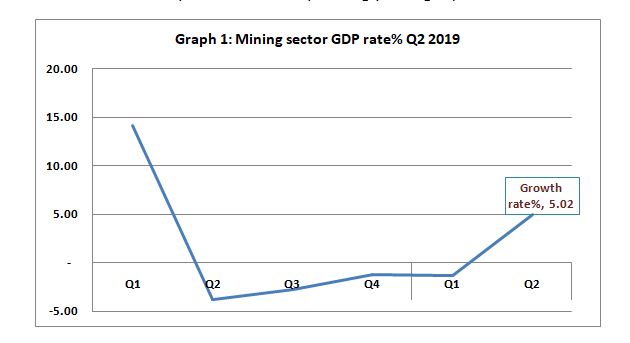
Recent data from the Nigerian Bureau of Statistics (NBS) Nigeria’s Gross Domestic Product (GDP) grew by 1.94% in Q2 2019. The Mining and quarrying sector contribution to GDP was 8.84 percent, a decline of 11.47 percent from Q1 2019 and 28.3 percent in corresponding year-ago quarter.
The real sector grew by 5.02% (year-on-year) during the second quarter of 2019. This was 8.85% points higher compared to the same quarter of 2018 and 6.38% points higher than the first quarter of 2019. On a quarter on quarter basis, the growth rate recorded was –0.72%. The contribution of Mining and Quarrying to Real GDP stood at 8.97%, slightly higher than 8.71% recorded in the corresponding quarter of 2018 but lower than 9.29% recorded in the first quarter of 2019.
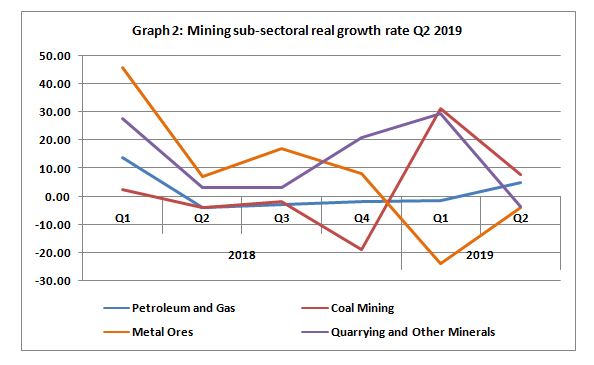
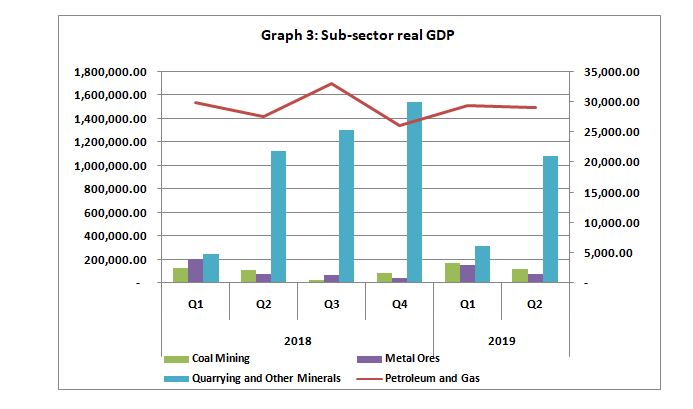
The chats in graph 3 show that crude petroleum and natural gas accounts for the most fractions in the Mining sector GDP, followed by quarrying. The representation in graph 3 shows the trend in the subsectors: the production of crude petroleum and natural rises and falls in the same pattern as quarrying, even though latter rises and falls faster. The trend also reveals some seasonality in quarrying as it falls sharply in Q1 and picks up in Q2. More so, there has been a significant uptick in the activities around metal ores and coal mining since the solid mineral roadmap in 2012 and 2016 – notwithstanding the seasonal deep in coal mining every Q3 and Q4 for metal ores activities since 2015.
Snapshot of solid minerals output by regions
The total output of solid minerals in Nigeria across states and regions in 2018 stood at 55.8 million tons compared to 45.8 million tons in 2017 and 43.44 million tons in 2016. South-west followed by North-central tops the list with a total output of 20 million ton 18.21 million respectively – accounting for 35.82 percent and 32.62 percent respectively.
The data from NBS show that Limestone alone accounted for 48.7 percent of the total production of solid minerals in 2018. Granite (17.24 percent), Laterite (9.08 percent) and Clay (7.21 percent) are among the largest solid mineral production. The laggards include Topaz, Ruby and Garnez.
Ogun state, South-west Nigeria retains the largest solid mineral output across the country. It is the major bolster in the region in terms of solid mineral production. Ogun state accounts for 29.53 percent of the total output in 2018—a 41.95 percent decrease from 2017. In 2017, the state claimed 50.89 percent of total national output. The graphics below shows a declining output since 2017.
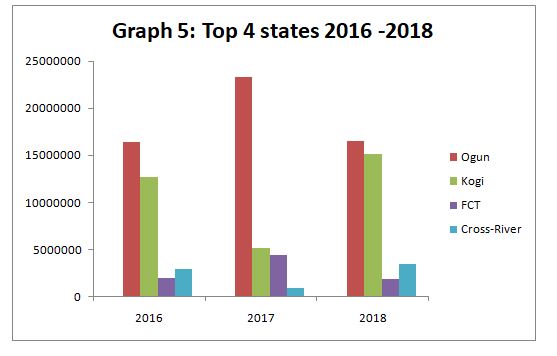
Kogi state is another top performer in terms of solid mineral production. Like Ogun in the South-west, it is the major anchor in the North-central. It recorded significant output growth between 2017 and 2018. It recorded an output growth of 189.45 percent between 2017 and 2018 contributing 27.1 percent of total national output in 2018. Other top performers include Cross-River and FCT with 6.25 percent and 3.4 percent respectively.
Plateau state – North-central – has the most varieties of mineral deposit with a count of 19 different solid mineral endowments. It, however, accounts for only 0.16 percent of national output. Nasarawa, another state in the North-central takes the second position in the count of mineral deposits with a total count of 13 different solid minerals. It suggests that the vast land in the region is richly endowed with a variety of mineral resources.
The South-east is the least in terms of output with a total production of 2 million tons representing 3.69 percent of the total national production. Whereas Ebonyi state is the lead performer in the region with significant production in granite and lead, Imo is the least performer with recorded production in Sand dredging alone.
The least performers across region include Borno (8403.30 tons), Rivers (19548.68 tons) and Yobe (41,591.49 tons). It is not clear whether the limitation in production in Borno and Yobe is due to insurgency in the region or the quantum of minerals available, but the overdependence in crude-oil exploration crowd-out interest in other sectors.
Remarks
In conclusion, there is room for progressive investments across regions dwelling on the mineral demographics. The positive trend in real GDP connotes positive efforts and feedback in the sector.However, the production output in Limestone, Granite and Clay suggests that explorations are lopsided towards cement and construction materials. It may be necessary to look into other diverse mineral endowments of economic importance; rely on the private sector participation and other stakeholders to expand the base of production.
2006/7 was when I first read Nigeria off the pages of a foreign textbook on development. I had little training on the matter, so it meant so much to me just reading that we were the ninth most populous country in world! I thought it meant recognition; you know, strength. We had just been head-counted to a high of about 142 million people. In another six years, an addition of over 27 million occurred, moving Nigeria up to the seventh most populous nation in the world. Today, forecasts predict over 300 million people by 2050, which will surpass the United States at the third position, after China and India. For now, it corridors around 191 million people.
According to the World Population Prospects report (2017), of the nine countries expected to contribute half of the world’s population from 2017 to 2050, Nigeria comes second after India and has the worst real GDP growth rate. Ethiopia is the second most populous in Africa at 101 million people over a total land area of 1,104,300 sq.km; relative to Nigeria, it implies an excess of 477 people per sq. km. Algeria and Congo DR are the largest countries in Africa with distinct land masses twice the size of Nigeria, but with populations 4 and 2 times less than Nigeria’s, respectively. They have, respectively, real GDP growth rates of 1.4 and 2.8 per cent, whereas we are barely recovering from the negative growth rate of 0.8 per cent. Algeria’s population today is over 5 million people less than Nigeria’s in 1960! We are increasingly losing the ability to feed even half of our population.
The population growth is due to a combination of factors, mainly: high fertility rate (5.13 births/woman), improved life expectancy (54.3 years) and decline in death rates. A look at the Nigerian population live clock delivered by Worldometer’s RTS algorithm presents a clear image of births every second. Uncontrolled population is a real problem in the context of one Earth. The Extremist argument attributes all the world’s economic and social evils – poverty, hunger, environmental degradation – to population explosion. Empirical research reveals that it instigates economic growth slowdown, poverty, food crisis, poor health conditions, increases in legal and illegal migration and environmental challenges. The world’s population of 7.6 billion, with a projection of over 9.8 billion by 2050, calls for global concerns, especially in Africa, from where most of the increase would come. Nigeria represents 2.5 per cent of the world’s population; by argument, therefore, it contributes the same amount of global sustainability issues due to population explosion. No wonder there is competition for everything- from medical to security services, to transportation, schools and jobs.
Yet it is for us no scare that there is not an official population policy document, let alone an active one. China, India, Bangladesh, South Korea, and Singapore have adopted different programs: from official policy disincentives for large family size to more severe programs of sterilisation as measures to curtail population pressures. In Nigeria, the checks against population explosion are the unnatural–high mortality rate, terrorism and epidemic. July 11, 2017, was World Population Day, and it was marked by the usual lip service of bandying around family planning buzzwords and speaking to figures and statistics. A classic case of all talk, no action. Senator Ben Murray-Bruce aptly captures the folly in thinking our population is an asset instead of the liability that it is. A concerted government effort on population is inevitable for a country like Nigeria, where half of the population exists below the poverty threshold. As Todaro and Smith (2006) put it, “it is not numbers per se or parental irrationality that is at the root of the LDC ‘population problem’. Rather, it is the pervasiveness of absolute poverty and low levels of living that provides the economic rationale for large families and burgeoning populations. And it is the spillover effects or negative social externalities of these private parental decisions […] that provide the strictly economic justification (in terms of ‘market failure’ argument) for government intervention in population matters”. These family planning advocacies alone are ineffective. A more stringent measure is long due.
Given our cultural and religious orientation, the sterilisation policy for married couples, even though efficacious, may meet widespread criticisms. Hence, a combination of policy alternatives such as economic incentives and disincentives for large family size, legislation to improve the social and economic status of women, alongside established family-planning programs, would get better reception. A more stringent policy would be to legislate on the minimum age of marriage for women to 30 years and a maximum of two children. Children born outside of this legal condition would attract medical bills (at market rate) borne by the parents and may not be considered for some social benefits, even though they would be citizens. Such children would be the direct responsibility of their parents. This would effectively moderate the fecundity of the population, attacking the problem from its roots, and extend the timeline of personal development for the girl-child. A rigorous effort against child marriages and girl-child education should be promoted across the country. Cash transfers and a coupon system could be inaugurated to benefit only small family sizes. However, an established social security and citizen database is a prerequisite for this to work. Again, the official employment benefits for workers and civil servants, such as family health insurance and accommodation, should be reduced to cover a maximum family size of four (down from six).
Overall, these issues should not be subordinate to cultural beliefs and religious interpretations. Unchecked population has degenerating consequences for sustainable living. The traditional monarchs and grassroots leaders should be involved in promoting this agenda. Combating population issues should be included in the development agenda. Another implication of this is the subtle repeat of history: African labour built Europe and America in the slave era, and African youths are already beginning to sustain their economy in light of their ageing population through migration.
[vc_row css=”.vc_custom_1615061238881{margin-top: 15px !important;margin-right: 80px !important;margin-left: 80px !important;padding-top: 15px !important;}”][vc_column width=”1/2″][vc_single_image image=”13151″ img_size=”large”][/vc_column][vc_column width=”1/2″ css=”.vc_custom_1610547821936{margin-top: 20px !important;padding-top: 20px !important;}”][vc_column_text]
The Expert Area Data and Analytics is developing two measures – Political Pessimism and Corruption Pessimism – that capture how the residents in a country perceive the government and its policy actions. The indices rely on natural language processing of social media and news media to quantify optimism or pessimism about governments’ policy decisions, pronouncements, or actions. The Indices will be published monthly to enable political risk analyses. The scope is limited to Nigeria with the possibility of expansion to cover select other African countries.
The target release date for the Corruption Pessimism Index is the third quarter (Q3) 2021 (dates to be announced). We are open to partnerships, sponsorships, and collaboration to run the program, maintain the database, and expand the scope beyond Nigeria to other African countries.
[/vc_column_text][vc_column_text]
For inquiries, send an email to consult@nativeinsightng.com or call +234 904 800 6929.
[/vc_column_text][/vc_column][/vc_row]